Highlights
- Munger Fort walls & Lal Darwaza — Walk the ramparts on the river side at dusk..
- Pir Shah Nafah's dargah — Sufi shrine inside the fort with a Bengal-sultanate inscription..
- Bihar School of Yoga — Ganga Darshan ashram; visitors welcome at set hours..
- Sita Kund — Hot spring and temple 6 km east..
Munger's fort stands on a rocky outcrop in a bend of the Ganga, with the river on two sides and a moat on the others — a position so good that everyone from the Guptas to the Nawabs of Bengal held it. Mir Qasim moved his capital here from Murshidabad in 1762 to be out of reach of the East India Company, built an arsenal and cast cannon; it did him no good, and after Buxar the British made it a cantonment.
Inside the walls are the 18th-century Lal Darwaza gate, the tomb of Pir Shah Nafah with its 1497 inscription, the Palace of Shah Shuja, a small Krishna temple and, in the former British bungalow of the collectorate, the Bihar School of Yoga's Ganga Darshan ashram, which since 1964 has drawn students from across the world.
Outside town, Sita Kund's hot spring is said to mark Sita's trial by fire, and the ghats at Kashtaharni are where the Ganga turns briefly north. Munger is also, quietly, the gun-making town of India, licensed and otherwise.
Chapter 01
How it came to be
Munger's bluff above the Ganga was fortified by Sher Shah and the Mughals, but its moment came in 1762 when Mir Qasim, Nawab of Bengal, moved his capital here to be out of the East India Company's reach in Murshidabad. He built an arsenal and a gun factory, trained a European-style army, and lost everything at Buxar two years later. The Company kept the gunsmiths — Munger made firearms for the British through the 19th century, and still makes them, legally and otherwise.
The 1934 earthquake flattened the old town. In 1964 Swami Satyananda Saraswati founded the Bihar School of Yoga on the fort's Ganga Darshan hill, which has since made Munger a name in every yoga studio in the world.
Chapter 02
What it's like now
The fort is a walled town: inside its circuit are the Collectorate, the jail, a Sufi shrine (Pir Shah Nafah), the tomb of a Mughal governor, the Kashtaharini ghat where the Ganga briefly flows north, and the yoga school's calm hilltop campus. The Lal Darwaza gate with its Mughal panels is the set-piece; the ramparts give long views over the river to the Kharagpur hills.
Sita Kund, eight kilometres east, is a hot spring where Sita is said to have proved her purity by fire; its water is close to boiling. Bhimbandh, 50 km south in the forested Kharagpur hills, has more hot springs in a wildlife sanctuary. Munger is also the gateway to Jamalpur's railway workshop (1862), the oldest in India.
Chapter 03
What to see
- 01
Munger Fort walls & Lal Darwaza
Walk the ramparts on the river side at dusk.
- 02
Pir Shah Nafah's dargah
Sufi shrine inside the fort with a Bengal-sultanate inscription.
- 03
Bihar School of Yoga
Ganga Darshan ashram; visitors welcome at set hours.
- 04
Sita Kund
Hot spring and temple 6 km east.
- 05
Kashtaharni Ghat
Riverside ghat where the Ganga flows north; Chhath here is beautiful.
Chapter 04
8 temples & sights, one by one
- 01
Fort · 14th–18th c.
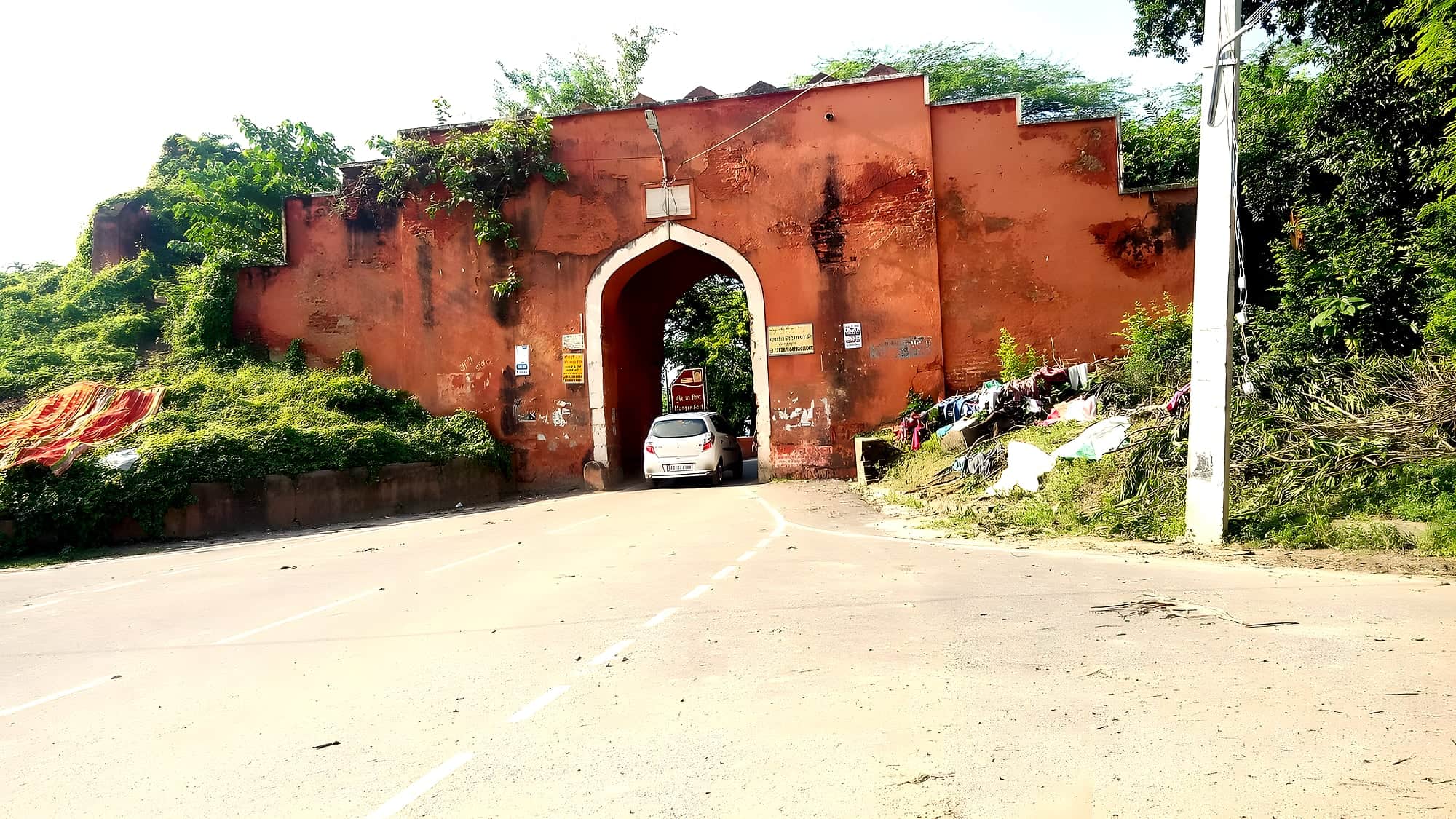
Munger Fort
Four kilometres of wall on a rocky bluff over the river, with the Lal Darwaza gate, a moat on the landward side and the administrative town inside. Built by the Bengal sultans, enlarged by Mir Qasim when he moved his capital here in 1762 to be out of the Company's reach.
- Where
- On the Ganga, town centre
© Nelgogle · CC BY-SA 4.0 - 02
Sufi · 1497 inscription
Pir Shah Nafah's dargah
The shrine of a Sufi who came to Munger in the 1100s, with an inscription of Sultan Husain Shah of Bengal; the Thursday evening qawwali and the Urs in Zil-Hijja are the fort's living side.
- Where
- Inside the fort, south gate
- 03
Yoga · 1963
Bihar School of Yoga — Ganga Darshan
Swami Satyananda's ashram, the mother house of the Satyananda yoga lineage taught worldwide. Not a drop-in studio — courses run by application — but the campus and its river view can be visited at the set hours.
- Where
- Fort area, on the river bluff
- Hours
- Visitors 8–9 am and 4–5 pm
- 04
Hot spring · Ramayana
Sita Kund
A hot spring in a walled tank, said to mark the spot of Sita's agni pariksha — her heat passed into the water. Cooler tanks around it for bathing; the Magh Purnima mela is the big day.
- Where
- 6 km east
- 05
Ganga · uttar-vahini
Kashtaharni Ghat
One of the few places where the Ganga flows north, which makes a bath here 'remove all sorrows'. Rama and Lakshmana are said to have bathed here. The fort wall drops to the water; evening is the time.
- Where
- Below the fort walls
- 06
Shakti Peeth
Chandika Sthan
One of the 51 Shakti Peethas — Sati's left eye — set in a small temple beside a tank; Navratri nights bring large crowds and night-long devotion.
- Where
- 4 km north-east
- 07
Garden · British graves
Shri Krishna Vatika & Tomb of Mir Qasim's era
A quiet botanical garden near the collectorate, and the overgrown 18th-century European cemetery by the fort wall where Company officers of the Munger cantonment lie.
- Where
- Inside the fort
- 08
Forest · hot springs · 55 km
Kharagpur lake & Bhimbandh
The British-era reservoir in the Kharagpur hills, then the sal-forest sanctuary of Bhimbandh with its steaming springs — the natural day-trip from Munger. See the separate Bhimbandh page.
- Where
- South via Kharagpur
Chapter 05
A perfect day
6:30
Kashtaharini ghat at sunrise — the north-flowing Ganga; walk the ramparts.
8:30
Lal Darwaza, Pir Shah Nafah, the fort interior; Ganga Darshan if the ashram permits.
11:00
Sita Kund hot spring and the Chandika Sthan temple.
13:00
Lunch in town; the gunsmiths' lane (ask locally).
15:00
Drive to Bhimbandh (50 km) for the forest hot springs, or the Jamalpur workshop.
Chapter 06
Stay, eat, celebrate
Where to stay
Mid-range hotels in town; the Bihar School of Yoga accepts residential students, not tourists.
Where to eat
Ganga fish, litti and the town's famous sweets; Jamalpur's railway-colony canteens are a period piece.
Festivals & seasons
Sita Kund mela on Magh Purnima (January/February); Durga Puja across the town.
Practical
Getting there
Fly
Patna Airport (PAT) 180 km; Deoghar (DGH) 120 km.
Train
Munger station in town; Jamalpur Junction 8 km, a major junction on the Sahibganj loop.
Road
180 km east of Patna on NH-80 via Mokama and Barhiya; the Ganga bridge at Munger links to Begusarai and north Bihar.
On the map · Munger is at 25.3748°N, 86.4735°E in Munger district, about 178 km (4 h) by road from Patna.
Before you go · Best time to visit · Safety, dress code & money · What to eat nearby
Practical
Distances from Munger
Road distance and realistic driving time on Bihar roads — plan around these, not the straight line on a map.
From the gateway cities
| Bhagalpur → Munger | 69 km | 1½ h |
| Darbhanga → Munger | 136 km | 3 h |
| Patna → Munger | 178 km | 4 h |
| Muzaffarpur → Munger | 180 km | 4½ h |
| Gaya → Munger | 210 km | 5 h |
To nearby places
| Munger → Sultanganj | 39 km | 0½ h |
| Munger → Bhimbandh Wildlife Sanctuary | 45 km | 1 h |
| Munger → Kanwar Lake | 57 km | 1 h |
| Munger → Ashok Dham, Lakhisarai | 57 km | 1 h |
| Munger → Kusheshwar Asthan | 57 km | 1 h |
| Munger → Ugratara, Mahishi | 68 km | 1½ h |
| Munger → Bhagalpur | 69 km | 1½ h |
| Munger → Simultala | 93 km | 2 h |
| Munger → Nagi & Nakti Bird Sanctuaries | 95 km | 2 h |
| Munger → Vikramshila | 108 km | 2½ h |
| Munger → Mandar Hill | 108 km | 2½ h |
| Munger → Pawapuri | 129 km | 3 h |
Estimates: road ≈ 1.3 × straight-line, ~40 km/h average. All Bihar distances →