Highlights
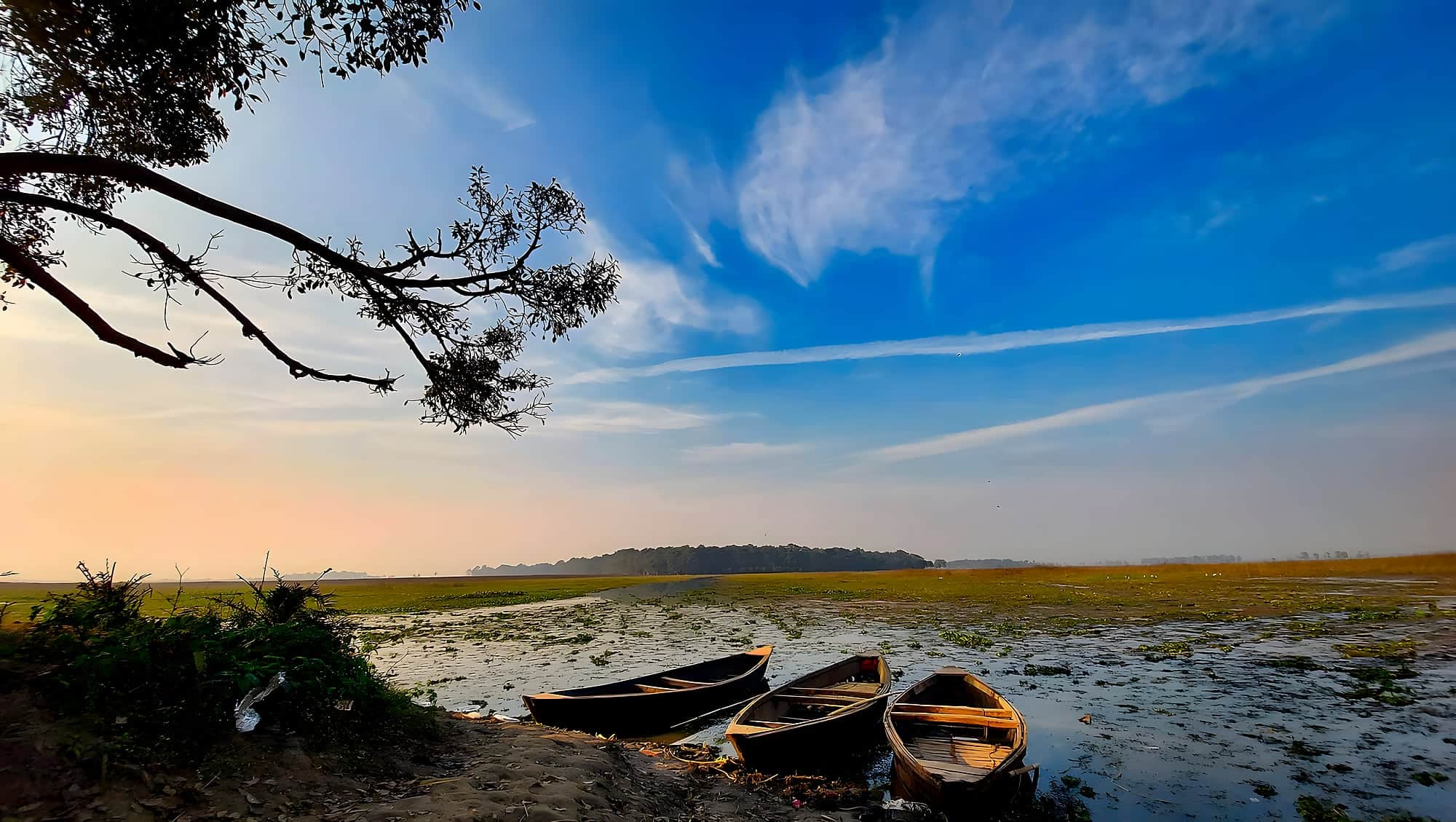
- Dawn boat ride — Hire a dugout at Manjhaul or Jaimangalgarh; two hours on the water at first light..
- Jaimangalgarh temple — Ancient Shakti shrine on an island mound in the lake..
- Winter waterfowl — December–February; bar-headed geese, pintail, teal, cotton pygmy goose..
When the Burhi Gandak changed course it left behind a crescent of water north of Begusarai so large that it is counted as Asia's biggest oxbow lake. Kabar Taal — Kanwar Jheel — shrinks and swells with the monsoon, from a few square kilometres of channels among fields to a 67-square-kilometre sheet, and in 2020 it became Bihar's first Ramsar wetland of international importance.
The birds are the point. Fifty-eight migratory species winter here along with over a hundred residents: bar-headed geese down from Tibet, pintails, garganey, ferruginous ducks, greylag geese, and raptors working the reedbeds. Local boatmen pole flat dugouts through the water-chestnut and lotus; the fishing communities around the lake have lived off it for generations and are, alongside the birds, what you come to see.
There is no infrastructure — no lodge, no visitor centre — which is both a problem and the reason it is still remarkable. Come as a day trip from Begusarai or Patna with a local birder.
Chapter 01
How it came to be
Kanwar — Kabar Taal — is where the Gandak once flowed, a great loop of the river abandoned as it shifted west, left to fill with rain and backflow every monsoon. For centuries it supported fishing villages and a famous migratory bird population; Salim Ali recorded it in the 1930s. It was notified as a bird sanctuary in 1989 and, after a long campaign, as Bihar's first Ramsar wetland in 2020.
The lake is also a case study in the pressures on Indian wetlands: siltation, encroachment for agriculture as the water shrinks each decade, and long disputes over land title among the 15,000 farming families in the notified area. The birds still come.
Chapter 02
What it's like now
In winter the water spreads into a shallow sheet with reed beds, lotus and water chestnut, and the birds arrive from Central Asia and Siberia: bar-headed geese, pintails, shovelers, garganey, cranes and pelicans, plus the resident darters, jacanas and herons. Country boats take you out among them from the Jaimanglagarh side, where a temple on an island — the Jaimangla Devi shrine — is the local pilgrimage.
Infrastructure is minimal: a watchtower, a small interpretation centre, boatmen you negotiate with. That is its charm and its problem. Go at dawn, hire a boat for two hours, and have the lake almost to yourself.
Chapter 03
What to see
- 01
Dawn boat ride
Hire a dugout at Manjhaul or Jaimangalgarh; two hours on the water at first light.
- 02
Jaimangalgarh temple
Ancient Shakti shrine on an island mound in the lake.
- 03
Winter waterfowl
December–February; bar-headed geese, pintail, teal, cotton pygmy goose.
Chapter 04
A perfect day
5:30
Leave Begusarai; at Jaimanglagarh by first light.
6:30
Two hours by country boat among the waterfowl.
9:00
Jaimangla Devi temple; tea in the village.
11:00
Return to Begusarai, or drive on to Munger (60 km) along the Ganga.
Chapter 05
Stay, eat, celebrate
Where to stay
Begusarai has reasonable hotels (it is a refinery town); nothing at the lake.
Where to eat
Village tea stalls; fish from the lake at Manjhaul market; Begusarai for meals.
Festivals & seasons
Navratri at Jaimangla Devi; the January bird census, when birders gather.
Practical
Getting there
Fly
Patna Airport (PAT) 130 km.
Train
Begusarai 22 km; Barauni Junction 25 km, on the main Delhi–Guwahati route.
Road
22 km north of Begusarai via Manjhaul; 130 km from Patna, 3 hours.
On the map · Kanwar Lake is at 25.6167°N, 86.1333°E in Begusarai district, about 130 km (3 h) by road from Patna.
Before you go · Best time to visit · Safety, dress code & money · What to eat nearby
Practical
Distances from Kanwar Lake
Road distance and realistic driving time on Bihar roads — plan around these, not the straight line on a map.
From the gateway cities
| Darbhanga → Kanwar Lake | 84 km | 2 h |
| Bhagalpur → Kanwar Lake | 124 km | 3 h |
| Muzaffarpur → Kanwar Lake | 124 km | 3 h |
| Patna → Kanwar Lake | 130 km | 3 h |
| Gaya → Kanwar Lake | 190 km | 4½ h |
To nearby places
| Kanwar Lake → Kusheshwar Asthan | 16 km | 30 min |
| Kanwar Lake → Ugratara, Mahishi | 55 km | 1 h |
| Kanwar Lake → Munger | 57 km | 1 h |
| Kanwar Lake → Ashok Dham, Lakhisarai | 64 km | 1½ h |
| Kanwar Lake → Darbhanga | 84 km | 2 h |
| Kanwar Lake → Bhimbandh Wildlife Sanctuary | 88 km | 2 h |
| Kanwar Lake → Sultanganj | 95 km | 2 h |
| Kanwar Lake → Madhubani | 107 km | 2½ h |
| Kanwar Lake → Pawapuri | 109 km | 2½ h |
| Kanwar Lake → Nalanda | 114 km | 2½ h |
| Kanwar Lake → Nagi & Nakti Bird Sanctuaries | 123 km | 3 h |
| Kanwar Lake → Bhagalpur | 124 km | 3 h |
Estimates: road ≈ 1.3 × straight-line, ~40 km/h average. All Bihar distances →