Highlights
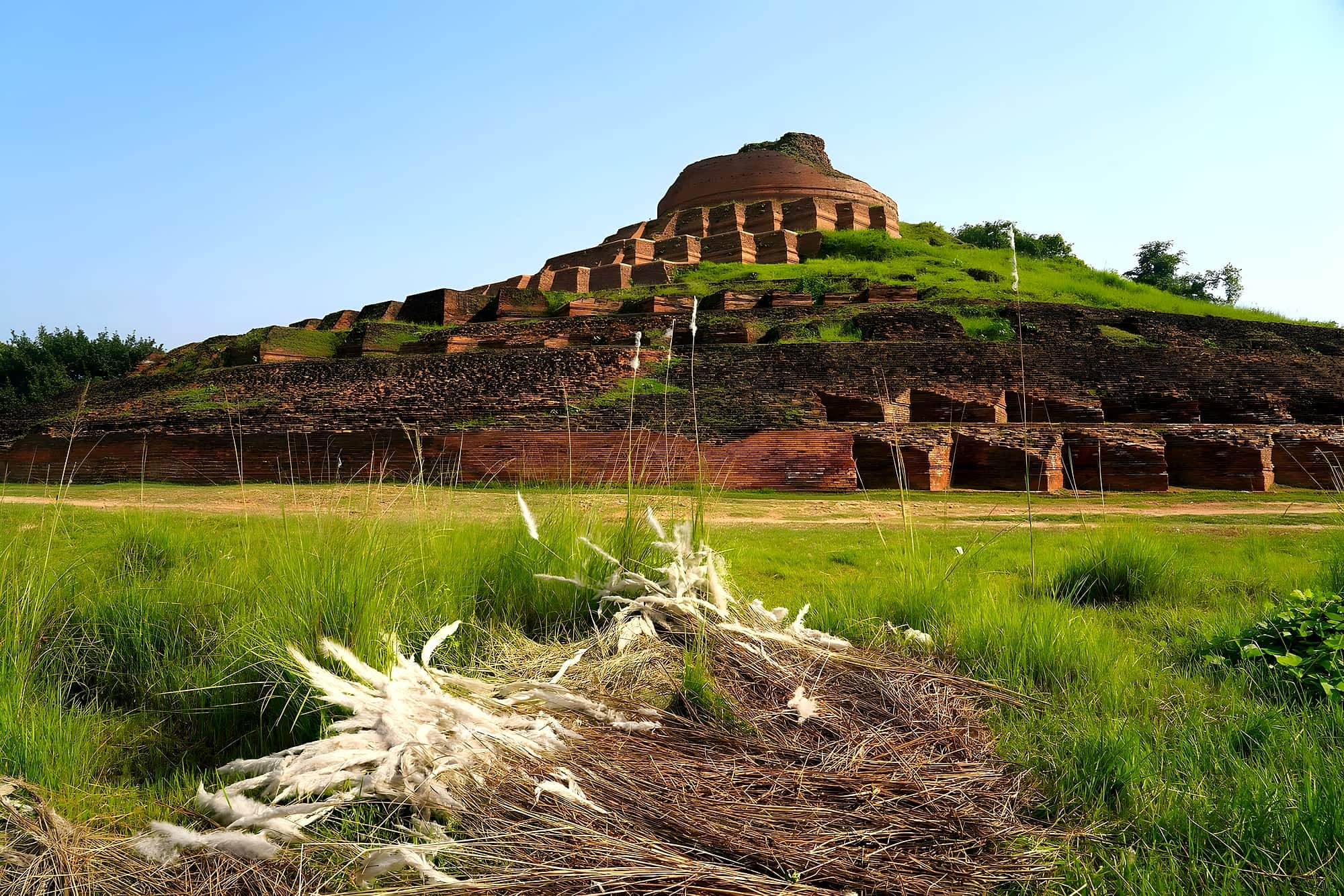
- The six terraces — Walk the ramps between terraces and look for the in-situ Buddha images in the niches..
- The unexcavated half — Stand where the dig stops and imagine the whole..
- Sunset across the fields — The brick turns copper; the site is nearly always empty..
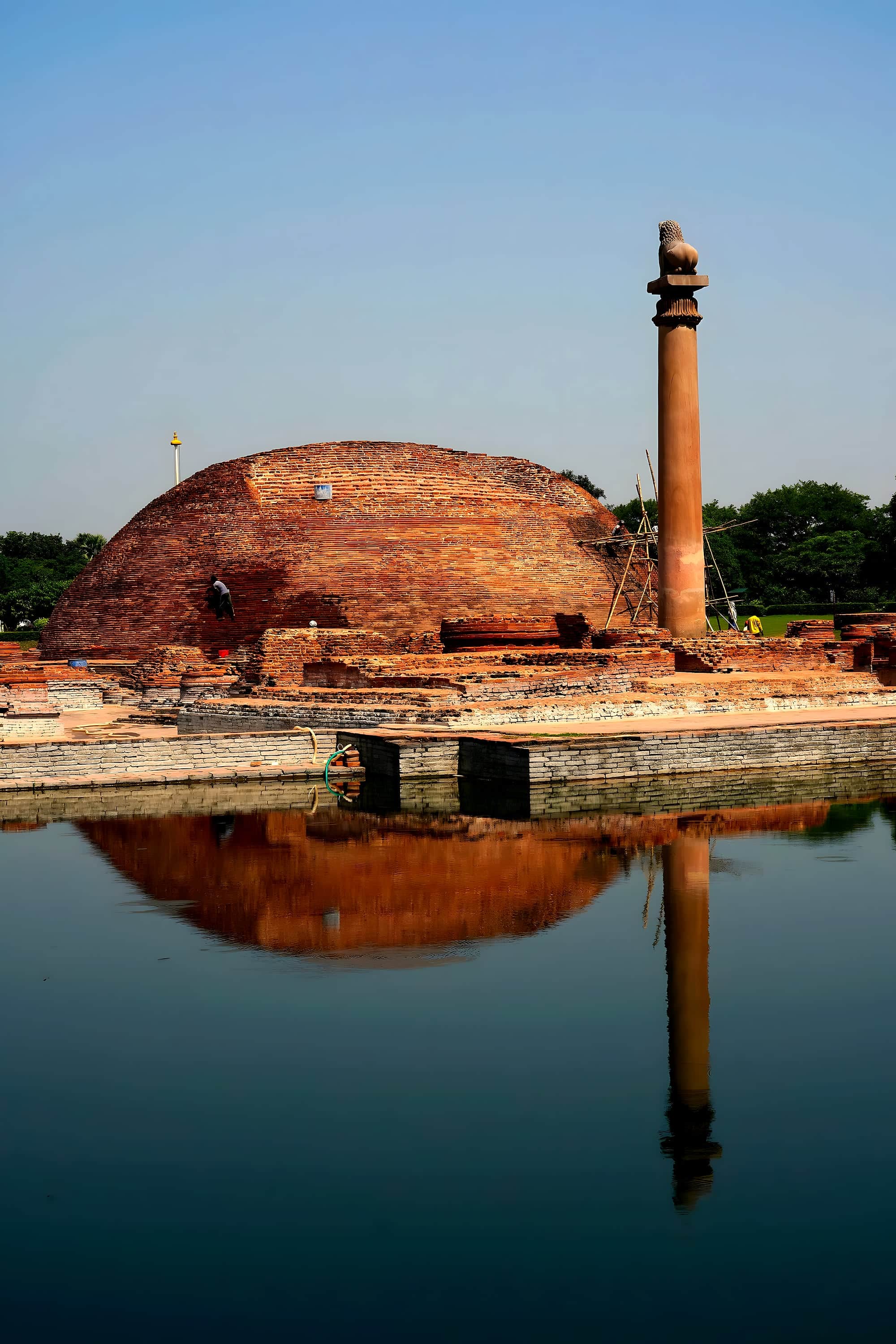
Walking north from Vaishali towards Kushinagar in the last months of his life, the Buddha is said to have stopped here, told the Licchavis who followed him to turn back, and given them his alms bowl as a parting gift. They raised a mound. Ashoka raised a bigger one on top of it; the Guptas and Palas built again, and by the 8th century Kesaria was a terraced brick mountain of shrines.
Then it was forgotten, became a grass-covered hill with a Shiva shrine on top, and was noted in passing by British surveyors. Excavation began in 1998 and revealed six terraces, each ringed with cells holding Buddha images, many still in place. The ASI puts the surviving height at 104 feet — the original is estimated at over 150 — and the circumference at 1,400 feet, which makes it larger than Borobudur and the largest stupa in the world.
Half the mound is still under earth and trees; you can see the excavation stopping in a clean line. There is no town to speak of, just fields of sugarcane and mustard, which is exactly why it is worth going.
Chapter 01
How it came to be
Here, by tradition, the Buddha on his last journey gave his begging bowl to the Licchavis of Vaishali who had followed him, and told them to turn back. A stupa marked the spot by Ashoka's time; the Licchavis enlarged it, and the Gupta and Pala kings built it up tier on tier until it was 150 feet high — taller than Borobudur, which it resembles. The Chinese pilgrim Xuanzang described it in the 7th century.
The stupa was abandoned after the Pala period, lost its top in the 1934 earthquake, and became a jungle-covered hill called Raja Ben ka Deora by the local people. The ASI began clearing it in 1998 and found a stepped terraced monument of brick, with life-size Buddha statues in niches on each of its six surviving tiers.
Chapter 02
What it's like now
Kesaria is still half-excavated and all the more striking for it: a man-made brick mountain in a landscape of flat paddy, with trees growing from its upper slopes and stucco Buddhas in the cleared niches below. You can walk round the lower terraces; the view from the road at sunset, with the stupa dark against the sky, is the photograph.
It is on nobody's circuit, which means an hour alone with the largest stupa on earth. Combine it with Vaishali on the way north to Champaran, or with Lauriya Nandangarh and Areraj — the Ashokan pillars of the old royal road — on the way to Valmiki.
Chapter 03
What to see
- 01
The six terraces
Walk the ramps between terraces and look for the in-situ Buddha images in the niches.
- 02
The unexcavated half
Stand where the dig stops and imagine the whole.
- 03
Sunset across the fields
The brick turns copper; the site is nearly always empty.
Chapter 04
A perfect day
Morning
Vaishali's Kolhua and relic stupa (from Patna, 2 hours).
13:00
Lunch at Chakia or Kesaria bazaar.
14:30
Kesaria stupa — walk the terraces, the niches, the excavated monastery.
17:00
Sunset from the field road; onward to Motihari (40 km) or back to Patna.
Chapter 05
Stay, eat, celebrate
Where to stay
None at Kesaria; Motihari (40 km) or Muzaffarpur (70 km) have hotels. Bihar Tourism has plans for a guesthouse.
Where to eat
Tea and snacks at the bazaar; dhabas on NH-28 at Chakia.
Practical
Getting there
Fly
Patna Airport (PAT) 110 km.
Train
Chakia 20 km on the Muzaffarpur–Narkatiaganj line; Motihari 35 km.
Road
110 km from Patna via Hajipur and Vaishali, 3 hours; 55 km from Muzaffarpur.
On the map · Kesaria Stupa is at 26.3339°N, 84.8547°E in East Champaran district, about 111 km (2½ h) by road from Patna.
Before you go · Best time to visit · Safety, dress code & money · What to eat nearby
Practical
Distances from Kesaria Stupa
Road distance and realistic driving time on Bihar roads — plan around these, not the straight line on a map.
From the gateway cities
| Muzaffarpur → Kesaria Stupa | 73 km | 1½ h |
| Patna → Kesaria Stupa | 111 km | 2½ h |
| Darbhanga → Kesaria Stupa | 137 km | 3 h |
| Gaya → Kesaria Stupa | 223 km | 5½ h |
| Bhagalpur → Kesaria Stupa | 319 km | 7½ h |
To nearby places
| Kesaria Stupa → Thawe Mandir | 60 km | 1½ h |
| Kesaria Stupa → Vaishali | 61 km | 1½ h |
| Kesaria Stupa → Sitamarhi | 89 km | 2 h |
| Kesaria Stupa → Maner Sharif | 99 km | 2 h |
| Kesaria Stupa → Sonepur Mela & Hariharnath | 100 km | 2½ h |
| Kesaria Stupa → Lauriya Nandangarh | 111 km | 2½ h |
| Kesaria Stupa → Patna | 113 km | 2½ h |
| Kesaria Stupa → Darbhanga | 137 km | 3 h |
| Kesaria Stupa → Jagdishpur & Arrah | 138 km | 3 h |
| Kesaria Stupa → Madhubani | 158 km | 3½ h |
| Kesaria Stupa → Buxar | 159 km | 3½ h |
| Kesaria Stupa → Valmiki National Park | 180 km | 4½ h |
Estimates: road ≈ 1.3 × straight-line, ~40 km/h average. All Bihar distances →
Practical
Kesaria Stupa tickets, entry fee & timings
What visitors have been paying recently. Fees change without notice — treat these as a planning guide and check the official page where one exists.
Kesaria Stupa (ASI)
- Hours
- Sunrise – sunset
- Fee
- Free.
- Booking
- No ticket. Allow 45 minutes; the site is roadside on the Patna–Raxaul route.