Bihar, practically
The questions everyone asks before a first trip — is it safe, what do I wear, does UPI work, where do I sleep, what do I say — answered plainly by people who travel here, not a brochure.
01
Is Bihar safe for tourists?
Is Bihar safe for tourists, couples and solo women?
Yes, with the same sense you would use anywhere in north India. The tourist corridor — Patna, Bodh Gaya, Nalanda, Rajgir, Vaishali — sees hundreds of thousands of foreign pilgrims a year and has a visible police and tourist-police presence. Petty theft on crowded trains and at melas is the realistic risk; violent crime against visitors is rare.
Couples: hotels are relaxed about unmarried couples in Patna and Bodh Gaya; smaller towns may ask for ID. Public affection draws stares; hand-holding is fine.
Solo women: travel by day between towns, use app cabs or pre-paid taxis at night in Patna, sit in ladies' coaches on local trains, and dress as the section below describes. Bodh Gaya and Rajgir are easy; Gaya town at night and remote waterfall roads are better with company.
Avoid: driving after dark on rural roads (unlit, livestock, no signage), and the Kosi–Gandak flood belt in July–September.
02
What to wear
Is there a dress code in Bihar's temples and monasteries?
Everyday: loose cotton, shoulders and knees covered for both sexes — it is as much about sun and dust as modesty. A scarf (dupatta) solves most situations for women.
Hindu temples (Vishnupad, Mundeshwari, Patna's Mahavir Mandir): remove shoes, cover shoulders; leather belts and bags sometimes refused. Non-Hindus are not admitted to the inner sanctum at Vishnupad.
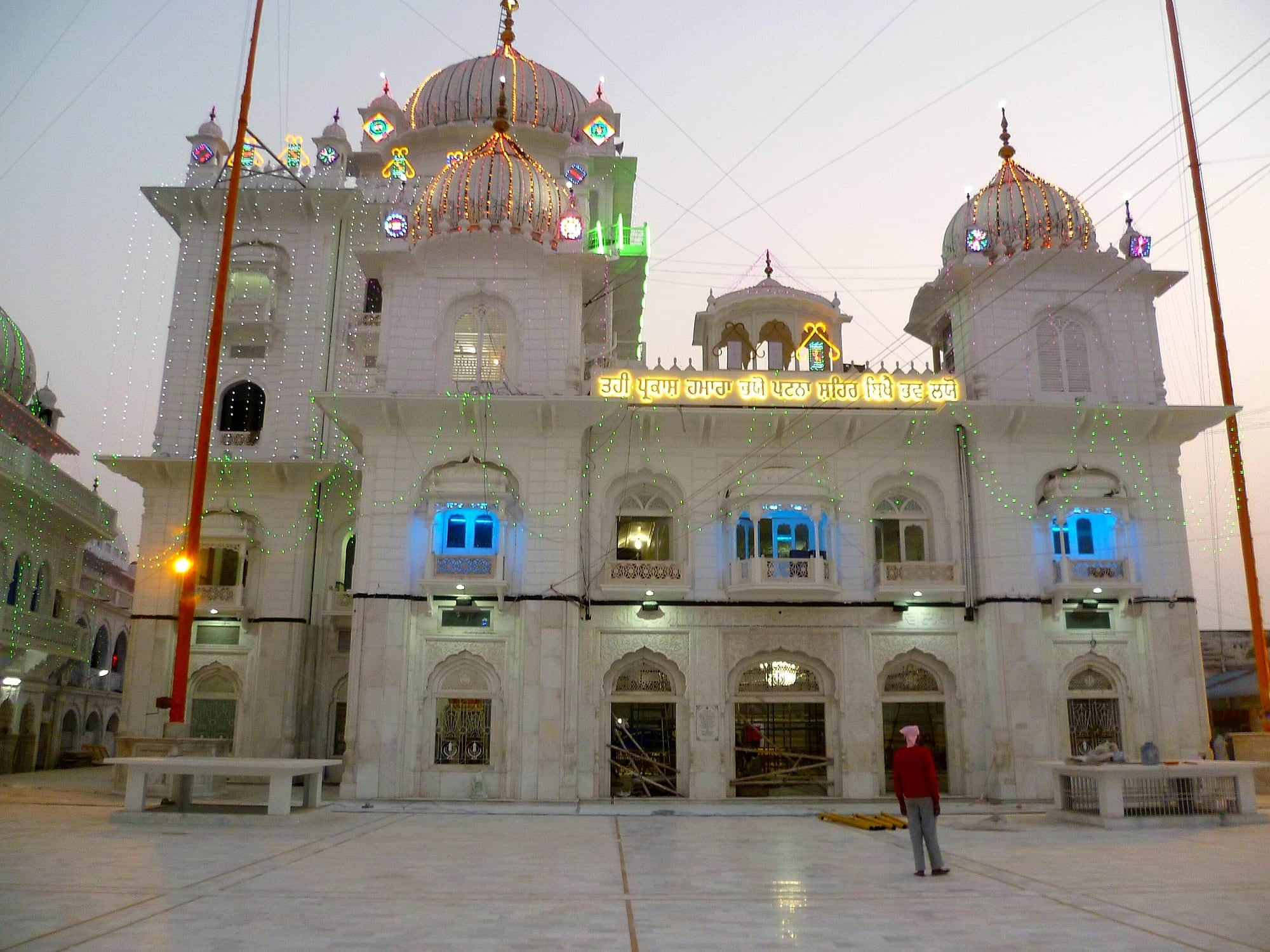
Takht Sri Patna Sahib and other gurdwaras: cover your head (scarves provided), remove shoes and socks, no tobacco or alcohol on you, wash feet at the entrance.
Buddhist sites: shoes off inside Mahabodhi; silent zones around the Bodhi tree; no shorts in monasteries. Photography is free at Mahabodhi but cameras need a ticket at ASI monuments like Nalanda.
Mosques and dargahs (Maner Sharif, Bihar Sharif): head covered, full-length clothing, remove shoes.
03
Money
Can I use cards and UPI in Bihar?
UPI (Google Pay, PhonePe, Paytm) works at nearly every stall and auto in towns — if you have an Indian bank account. Foreigners can use UPI One World prepaid wallets at airports, or carry cash.
ATMs are plentiful in Patna, Gaya, Bhagalpur and Muzaffarpur; sparse at waterfalls, Valmiki and small pilgrimage towns. Draw cash before leaving a district HQ.
Cards: accepted at hotels and larger restaurants only. Keep ₹500 and ₹100 notes; ₹2,000 notes are withdrawn.
Typical costs: auto within town ₹30–100, e-rickshaw ₹10–30 a hop, thali ₹120–250, litti plate ₹40–60, budget room ₹800–1,500, good 3-star ₹3,000–4,500.
04
Where to stay
What are the hotel options in Bihar?
BSTDC (Bihar State Tourism Development Corporation) runs clean, plainly furnished hotels in Patna, Bodh Gaya, Rajgir, Vaishali, Valmiki Nagar and more — book on bstdc.bih.nic.in; reliable and well located if not luxurious.
Bodh Gaya: monastery guesthouses (Burmese Vihar, Bhutanese, Thai, Japanese) take travellers for ₹500–1,500 outside teaching season; several good 3–4 star hotels line the Dungeshwari road.
Patna: Fraser Road, Boring Road and Bailey Road for business hotels; Patna Junction area for budget. Rajgir: hotels cluster at the hot-springs end and along the Nalanda road.
Pilgrim towns (Gaya, Sultanganj, Sitamarhi, Pawapuri) have dharamshalas — basic rooms for a donation — and fill solid during melas. Valmiki Tiger Reserve has forest-department tree houses and eco-huts; book via the Bihar eco-tourism portal.
Homestays are growing in Madhubani villages and around Rajgir; Bihar Tourism runs a registration scheme, so ask for a registered one.
05
Getting around
How do I get around Bihar without a car?
Trains link every major town cheaply; book on IRCTC a few days ahead for AC chair car. Local passenger trains are slow but fine for Patna–Rajgir or Gaya–Dehri.
Hire a car with driver for 2–5 days from Patna or Gaya — ₹2,500–4,000 a day for a sedan including fuel within ~250 km; it is the only sane way to do the Kaimur waterfalls or Champaran.
Within towns: shared e-rickshaws and autos. Bodh Gaya, Rajgir and Nalanda are small enough to see by e-rickshaw or hired cycle; Rajgir has tongas (horse carts) too.
Apps: Ola/Uber in Patna and Gaya; nowhere else reliably. Bus: BSRTC and private AC coaches from Patna ISBT to Bodh Gaya, Rajgir, Muzaffarpur, Bhagalpur.
06
SIM, internet, power
Will my phone work in Bihar?
Jio and Airtel 4G cover every town and most highways; Valmiki forest and the Kaimur plateau drop to patchy. Foreigners can buy a tourist SIM at Delhi/Kolkata airports (passport + visa + photo) — easier than in Patna.
Power cuts are short and hotels have backup; carry a power bank for long temple days. Plugs are Indian type D/M (230 V).
Download offline maps for Google Maps and keep this site's place pages open — they work without a connection once loaded.
07
Language
What language is spoken in Bihar?
Hindi is understood everywhere; English in hotels, Bodh Gaya and by younger people in cities. The home languages are Bhojpuri (west: Patna to Champaran), Magahi (Gaya, Nalanda), Maithili (Darbhanga, Madhubani, Mithila) and Angika (Bhagalpur). Urdu is common in old Patna City and Bihar Sharif.
A few words of Hindi go a long way — see the phrasebook below. Bodh Gaya is multilingual in Thai, Tibetan, Burmese, Sinhala and Japanese; monks are happy to help translate.
08
Health & water
Any health precautions for Bihar?
Drink sealed bottled or filtered water only; skip ice outside good hotels. Street food is excellent — pick busy stalls that cook in front of you, especially litti.
Mosquitoes year-round, worst July–October; repellent and long sleeves at dusk. Routine vaccines plus hepatitis A and typhoid are the usual advice; malaria is low-risk in towns.
Heat: April–June needs 3–4 litres of water a day and a siesta. Pharmacies are everywhere; good private hospitals in Patna (Paras, Ruban, Medanta), basic elsewhere.
09
Phrasebook
| English | Hindi | Say it |
|---|---|---|
| Hello / goodbye | नमस्ते | NamastePranaam (प्रणाम) is the warmer Bihari form, especially to elders. |
| Thank you | धन्यवाद | Dhanyavaad |
| How much is this? | यह कितने का है? | Yeh kitne ka hai? |
| Too expensive | बहुत महंगा है | Bahut mehnga hai |
| Where is …? | … कहाँ है? | … kahan hai? |
| Railway station | रेलवे स्टेशन | Railway station |
| Vegetarian food only | सिर्फ शाकाहारी खाना | Sirf shakahari khana |
| Less spicy, please | कम मिर्च, कृपया | Kam mirch, kripya |
| Water (sealed bottle) | पानी (बोतल) | Paani (bottle) |
| Help! | मदद! | Madad! |
| I don't understand | मुझे समझ नहीं आया | Mujhe samajh nahin aaya |
| Is it far? | क्या दूर है? | Kya door hai? |
| How are you? (Bhojpuri) | का हाल बा? | Ka haal ba?Bhojpuri — west Bihar |
| How are you? (Maithili) | की हाल अछि? | Ki haal achhi?Maithili — Mithila, north-east |
10
Emergency numbers
- All emergencies (police, fire, ambulance)112
- Police100
- Ambulance108
- Women's helpline181
- India tourist helpline (24×7, 12 languages)1800-11-1363
- Railway helpline139
All work from any Indian SIM without a code. Save your hotel’s number and your embassy’s Delhi or Kolkata line too. For scams or harassment at a site, the on-site tourist police post is faster than 100.