Highlights
- Lomas Rishi cave — The carved chaitya-arch doorway — the first of its kind..
- Sudama cave — Dated 261 BCE by its inscription; the finest polish and echo..
- Karan Chaupar & Visvakarma — The other two Ashokan caves; Visvakarma reached by a rock-cut stair..
- Nagarjuni caves — Dasharatha's three caves on the next hill, 1 km away..
The Barabar hills are a cluster of bare granite domes rising out of the Magadh plain 35 km north of Gaya. In the reign of Ashoka, around 260 BCE, workmen cut four chambers into the rock and dedicated them, in inscriptions you can still read, to the Ajivikas — a sect of fatalist ascetics now entirely vanished. Three more caves on the neighbouring Nagarjuni hill were added by Ashoka's grandson Dasharatha.
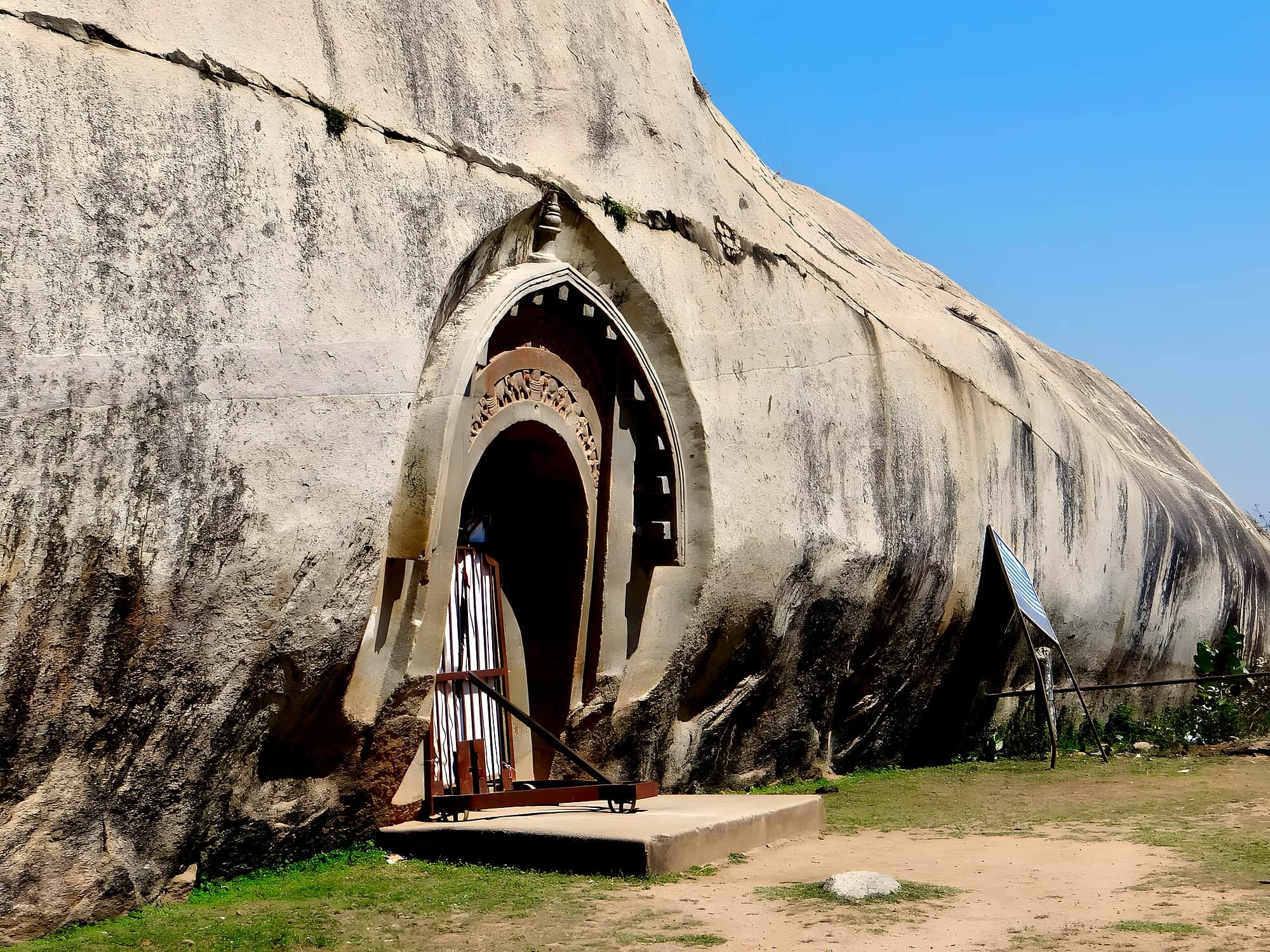
Nothing prepares you for the interiors. The chambers are plain — a rectangular hall and a round cell — but every surface is ground to the famous 'Mauryan polish', smooth and reflective as glass after 2,300 years, and the acoustics turn a hum into a long shimmering drone. The Lomas Rishi cave has the oldest carved doorway in India: a horseshoe arch with a frieze of elephants that every later Buddhist chaitya hall copied in stone.
E. M. Forster set the pivotal scene of A Passage to India in these caves, renamed Marabar. The site is approached by a stair up the rock, with a Shiva temple on top and a view over the plain towards Gaya.
Chapter 01
How it came to be
The granite hills of Barabar rise out of the plain north of Gaya like whalebacks, and in the 260s BCE Ashoka's masons cut four chambers into them for the Ajivikas — an ascetic sect, rivals of the Buddhists and Jains, who went naked and believed in absolute fate. His grandson Dasharatha cut three more at Nagarjuni next door. They are the first rock-cut caves in India, and the ancestors of Ajanta and Ellora.
The Ajivikas vanished within a few centuries. The caves stayed open and a 5th-century king defaced some inscriptions; a Shiva temple grew up on the hilltop; and in 1924 E. M. Forster made them, as the Marabar Caves, the dark heart of A Passage to India — the place where the echo swallowed every meaning.
Chapter 02
What it's like now
The Lomas Rishi cave is the one everybody comes for: a doorway carved to imitate a wooden hut, with a frieze of elephants bowing to a stupa, the earliest ogee arch in India and the model for every chaitya window after it. Inside, the chambers are plain and polished to a mirror finish — the 'Mauryan polish' that no one has quite explained — and clap once and the echo comes back twenty times, exactly as Forster wrote.
A steep flight of steps climbs to the Siddheshwar Nath temple on the summit for a view over the whole Magadh plain to Gaya. Nagarjuni's caves are a kilometre's walk through a quiet valley. The site has a new approach road and ticket counter but remains lightly visited; a local guide with a torch is useful for the inscriptions.
Chapter 03
What to see
- 01
Lomas Rishi cave
The carved chaitya-arch doorway — the first of its kind.
- 02
Sudama cave
Dated 261 BCE by its inscription; the finest polish and echo.
- 03
Karan Chaupar & Visvakarma
The other two Ashokan caves; Visvakarma reached by a rock-cut stair.
- 04
Nagarjuni caves
Dasharatha's three caves on the next hill, 1 km away.
- 05
Siddheshwar Nath temple
On the summit of Barabar hill; sunset view.
Chapter 04
A perfect day
7:30
Leave Gaya or Bodh Gaya; at the Barabar foot by 9.
9:00
Lomas Rishi and Sudama caves — the doorway, the polish, the echo.
10:30
Climb to Siddheshwar Nath temple; views over Magadh.
12:00
Walk to Nagarjuni hill for the Gopika and Vadathika caves.
14:00
Lunch in Makhdumpur; on to Rajgir (60 km) or back to Gaya.
Chapter 05
Stay, eat, celebrate
Where to stay
Day trip from Gaya/Bodh Gaya or Rajgir; nothing on site.
Where to eat
Tea stalls at the foot; carry water for the climb. Dhabas at Makhdumpur and Jehanabad.
Festivals & seasons
Shravan (July–August) and Mahashivratri, when pilgrims climb to the Shiva temple in large numbers.
Practical
Getting there
Fly
Gaya Airport (GAY) 40 km.
Train
Gaya Junction 35 km; Makhdumpur 12 km.
Road
35 km north of Gaya off the Gaya–Patna road, via Makhdumpur. Taxi from Bodh Gaya, 1.5 hours.
On the map · Barabar Caves is at 25.0072°N, 85.0631°E in Jehanabad district, about 88 km (2 h) by road from Patna.
Before you go · Best time to visit · Safety, dress code & money · What to eat nearby
Practical
Distances from Barabar Caves
Road distance and realistic driving time on Bihar roads — plan around these, not the straight line on a map.
From the gateway cities
| Gaya → Barabar Caves | 32 km | 0½ h |
| Patna → Barabar Caves | 88 km | 2 h |
| Muzaffarpur → Barabar Caves | 166 km | 4 h |
| Darbhanga → Barabar Caves | 198 km | 4½ h |
| Bhagalpur → Barabar Caves | 254 km | 6 h |
To nearby places
| Barabar Caves → Gaya | 32 km | 0½ h |
| Barabar Caves → Bodh Gaya | 46 km | 1 h |
| Barabar Caves → Rajgir | 47 km | 1 h |
| Barabar Caves → Rajgir Nature Safari & Ghora Katora | 50 km | 1 h |
| Barabar Caves → Nalanda | 53 km | 1 h |
| Barabar Caves → Pawapuri | 63 km | 1½ h |
| Barabar Caves → Patna | 85 km | 2 h |
| Barabar Caves → Kakolat Falls | 91 km | 2 h |
| Barabar Caves → Maner Sharif | 96 km | 2 h |
| Barabar Caves → Deo Sun Temple | 97 km | 2 h |
| Barabar Caves → Sonepur Mela & Hariharnath | 102 km | 2½ h |
| Barabar Caves → Jagdishpur & Arrah | 107 km | 2½ h |
Estimates: road ≈ 1.3 × straight-line, ~40 km/h average. All Bihar distances →
Practical
Barabar Caves tickets, entry fee & timings
What visitors have been paying recently. Fees change without notice — treat these as a planning guide and check the official page where one exists.
Barabar & Nagarjuni caves (ASI)
- Hours
- Sunrise – sunset (practically 7:00 – 17:30)
- Fee
- Free. No camera fee.
- Booking
- No ticket. Torch essential — the Lomas Rishi and Sudama caves are unlit inside.