Highlights
- The octagonal sanctum — 2nd-century stonework; look at the doorframe carving..
- The bloodless offering — Mornings; ask before photographing..
- Hilltop views — Over the Kaimur plateau and the Durgavati reservoir..
- Karkat Garh waterfall — Seasonal fall and crocodile sanctuary 40 km away on the Durgavati..
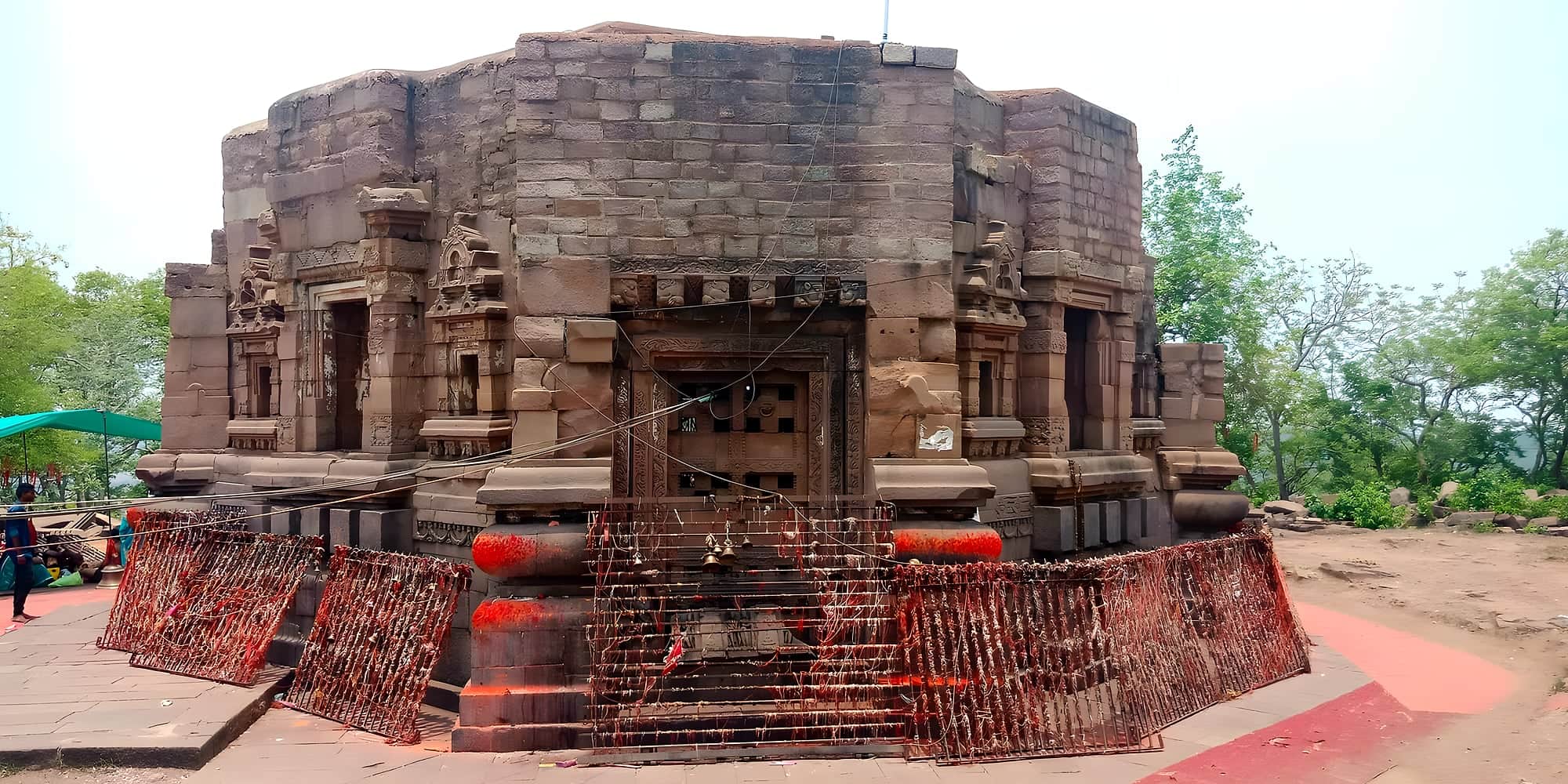
On a flat hilltop at Pawara, deep in the Kaimur hills west of Sasaram, stands a small octagonal temple of grey stone with a flat roof — the shikhara fell long ago — that the ASI dates on inscriptional evidence to 108 CE, in the reign of the Kushan king Huvishka. That makes it a candidate for the oldest Hindu temple in India still in worship.
The sanctum holds a chaturmukha (four-faced) Shiva lingam and an image of Mundeshwari, a form of Durga riding a buffalo; the temple is dedicated to both. The carving on the doorways — Ganesha, Surya, dvarapalas — is Gupta or earlier. Around the temple the hilltop is scattered with the stone fragments of what was once a much larger complex.
The ritual is as unusual as the building. Goats are offered to the goddess but not killed: the priest touches the animal with rice and it falls unconscious, then revives and is returned to its owner. The hill has views across the Kaimur plateau, and the drive up from Bhabua is through genuine countryside.
Chapter 01
How it came to be
An inscription found on the hill, dated to 635 CE in the Harsha era, records grants to a temple already standing — making Mundeshwari one of the oldest continuously worshipped temples in India. The octagonal stone shrine, its doorways carved with river goddesses and guardians, is a rare survivor of the Gupta–post-Gupta transition. The local story links it to the demon Mund, killed here by the goddess.
The temple lost its shikhara centuries ago (a flat roof replaces it) and was restored by the ASI, who found more than 90 sculptures on the hill — many now in the Patna Museum.
Chapter 02
What it's like now
A road climbs to a car park below the summit; from there steps lead up to a small, dark, intensely used temple on a bare hilltop with the Kaimur plateau falling away in every direction. Inside, the four-faced linga and the goddess share a chamber barely five metres across. The unusual rite here is a bloodless sacrifice: a goat is offered, touched with rice and mantra, falls as if dead, and is revived and returned to its owner.
The views are enormous — the plain to the north, the plateau south — and the site is busy only at Navratri. It pairs naturally with Sasaram and the Kaimur waterfalls.
Chapter 03
What to see
- 01
The octagonal sanctum
2nd-century stonework; look at the doorframe carving.
- 02
The bloodless offering
Mornings; ask before photographing.
- 03
Hilltop views
Over the Kaimur plateau and the Durgavati reservoir.
- 04
Karkat Garh waterfall
Seasonal fall and crocodile sanctuary 40 km away on the Durgavati.
Chapter 04
A perfect day
7:00
Leave Sasaram; via Bhabua, at the hill by 9.
9:00
The climb and the temple; the hilltop walk and the ASI sculpture shed.
11:30
Drive to Karkat Garh waterfall (40 km) or back through Bhabua.
Afternoon
Rohtasgarh approach or Sasaram's tombs at sunset.
Chapter 05
Stay, eat, celebrate
Where to stay
Bhabua has basic hotels; Sasaram is the practical base.
Where to eat
Prasad and tea at the temple; dhabas on the Bhabua road.
Festivals & seasons
Chaitra and Sharad Navratri — the hill fills; Mahashivratri.
Practical
Getting there
Fly
Varanasi Airport (VNS) 100 km.
Train
Bhabua Road (Mohania) 25 km on the Delhi–Howrah main line.
Road
70 km west of Sasaram via Bhabua; 1.5 hours. Road goes to the summit.
On the map · Mundeshwari Temple is at 25.0444°N, 83.5744°E in Kaimur district, about 220 km (5½ h) by road from Patna.
Before you go · Best time to visit · Safety, dress code & money · What to eat nearby
Practical
Distances from Mundeshwari Temple
Road distance and realistic driving time on Bihar roads — plan around these, not the straight line on a map.
From the gateway cities
| Gaya → Mundeshwari Temple | 190 km | 4½ h |
| Patna → Mundeshwari Temple | 220 km | 5½ h |
| Muzaffarpur → Mundeshwari Temple | 281 km | 7 h |
| Darbhanga → Mundeshwari Temple | 342 km | 8½ h |
| Bhagalpur → Mundeshwari Temple | 447 km | 11 h |
To nearby places
| Mundeshwari Temple → Bakhtiyar Khan's Tomb, Chainpur | 8 km | 15 min |
| Mundeshwari Temple → Shergarh Fort | 27 km | 45 min |
| Mundeshwari Temple → Telhar Kund & Karkatgarh | 52 km | 1 h |
| Mundeshwari Temple → Sasaram | 59 km | 1 h |
| Mundeshwari Temple → Dhua Kund & Manjhar Kund | 65 km | 1½ h |
| Mundeshwari Temple → Tutla Bhawani | 74 km | 1½ h |
| Mundeshwari Temple → Rohtasgarh Fort | 76 km | 1½ h |
| Mundeshwari Temple → Buxar | 92 km | 2 h |
| Mundeshwari Temple → Deo Sun Temple | 126 km | 3 h |
| Mundeshwari Temple → Jagdishpur & Arrah | 126 km | 3 h |
| Mundeshwari Temple → Maner Sharif | 190 km | 4½ h |
| Mundeshwari Temple → Gaya | 190 km | 4½ h |
Estimates: road ≈ 1.3 × straight-line, ~40 km/h average. All Bihar distances →
Practical
Mundeshwari Temple tickets, entry fee & timings
What visitors have been paying recently. Fees change without notice — treat these as a planning guide and check the official page where one exists.
Maa Mundeshwari Temple
- Hours
- ~5:30 – 20:00; aarti around 6:00 and 19:00
- Fee
- Free. Prasad and the symbolic bloodless 'bali' are by voluntary offering.
- Booking
- No ticket. A motorable road climbs most of the hill; the last steps are easy.